

Interactions among the People of Africa
The word Interaction refers to the process by which people come in contact with one another and influence each other. Inn pre-colonial Africa Interaction was a state in which people from one community got into contact with one another community and affect each other.
For example, in west Africa Between 8th – 16th C. AD communities from the Sudanic belt engaged in trade with the communities from north Africa in the Trans – Sahara trade this led to the introduction of Islamic religion, growth of states to the people of the Sudanic belt, intermarriage, and development of new technology.
In east Africa the Swahili coastal city states such as Kilwa, Mombasa, and Zanzibar flourishes due to trade with Arabs, Persian, and Indian merchants, which led to the development of unique afro Arab culture and language.
Interactions were major links and contacts which were established by the Africans since the late Stone Age and Iron Age up to the middle of the 19th century when Africa was not yet colonized by the Europeans.
FACTORS FOR EARLY INTERACTIONS IN THE PRE-COLONIAL AFRICA.
A. Social factors
Migration
East Africa belongs to four main language groups namely the Khoisan, the Cushites, the Nilotes and the Bantu. These early large groups interacted with the larger Cushites, Bantu and the Nilotes communities that began settling in East Africa from the first century A.D. Through interaction of one community practiced medicine interacted with another led to some changes such as introduction of iron technology in East Africa.
Religion
It played a crucial role in all African societies. Religious beliefs were taken seriously and affected every phase of life. There was a variety of religious activities in pre-colonial Africa. These included burial rites purifications, rituals naming of ceremonies and prayers to bless soldiers before they went to war.
Religious activities took place at different levels such as family level, clan level and community level e.g. The Bushmen of Congo held prayers before going to hunt as they believed that God was the source of all food.
Among the Asante people of West Africa the king of Asante (Asantehene) based his right to office on the possession of the Royal or Golden stool, Asantehene was regarded as the chief priest. Natural cults also existed in many parts of Africa. Their main aim was to please the spirits and legendary heroes e.g. the juju practiced in Western Africa the Shona held a cult called Mwari.
Wars
African communities engaged in war from time to time; they fought with various reasons such as to increase the number of the herds of livestock, to get fertile land for agriculture purposes and expansion of the kingdom e.g. Buganda conquered Buddu, Karagwe and Busoga to expand their kingdom by 1839.
Egyptian army had established their base at Gondokora the area located around Southern Khartoum and by 1869, Egyptian had raided and destroyed the Lango and Ancholi region in the modern day Uganda.
Music and dances
African music and dances brought people together; communities’ rites and ceremonies were accompanied by songs and dances. Every African society developed songs for work, Laborers sang while clearing fields, sowing and harvesting goods, example of dances were Mdundiko among the Zaramo and Sindimba of Makonde.
The Yomba of West Africa performed Orik music where by other songs praised or condemned certain characteristics including leadership and relation with neighbors. Dances were also performed for different purposes; some dances were open to everyone while others restricted to a certain secret society professional and artisans example Chagga men and women performed a dance called Rring during wedding ceremonies and Luguru led their dance called Gubi.
Medicine
African’s had medicine men and women who played important role both spiritually and medically. Those who practice medicine interacted with many members of the society as patient visited some of the well-known medicine men and women.
Some medicine men and women were also political advisors and leaders example Kinjekitile Ngwale of Southern Tanganyika most of the medicine were extracted from plant roots, barks and leaves e.g. The (neem tree) Mwarobaini was mostly used by various medicine in Matebele.
Marriage
Marriage occupies a position of great importance in African communities. Every member of the society jugs to build their own family. In Buganda the Kabaka married from different clans in order to enhance political unity in the kingdom. Therefore social interactions strengthened through marriage. At the same time marriage led to emergence of new culture examples Swahili culture as the result of mixture of Bantu and Arab culture
B. Economic factors
Africa communities also interacted due to economic factors such as:
Metal working
African communities used various kinds of metal to make tools, weapons, utensil and ornaments; some of the widely used metals were iron, Bronze, Gold, Copper and tin. Archaeologists have discovered the remains of early iron working beneath important religious shrine in the Great lakes region dating back over 2,000 years ago. Egyptians were the first people known to have used copper; Benin the Bronze casters had guild called Igun Eronwon, through making various metal tools people interacted due to the need of the commodities through interactions.
Agriculture
Many Africans communities practiced agriculture and different types of interaction took place in the process. Apart from few communities such as the pastoral Maasai who never tilled land; other communities cultivated a variety of crops by using different farming methods, tools and crops were passed from one community to another. The Kwavi who were purely pastoral community eventually became cultivators as the results of their interaction with agricultural societies.
Fishing
Was an economic activity that was practiced by communities that lived near water bodies such as lakes, rivers and the seas. The Luo were and still are named fishermen in Pre-colonial East Africa, the Ndengereko’s fished in the river Rufiji while the Zaramo and other coastal people in the Indian Ocean, such fishing communities interacted with pastoralists and agriculturalists so as to acquire animal product and agricultural commodities.
Trade
Trade conducted in pre-colonial period was in barter system, the trade network was based on the need to access what a community didn’t produce; Example pastoralists exchanged their animals’ products for vegetable and grains. The limbo clans among the Luo specialized in occupation such as iron working and pottery. Between 8th – 16th C. AD communities from the Sudanic belt engaged in trade with the communities from North Africa in the Trans – Sahara trade. Among the most important commodities of exchange were iron, gold, slaves and salts
The need to search new areas
Areas with fertile land and reliable rainfall were very attractive to the people within the regions or those coming from outside the regions. Agricultural societies kept on shifting from the area with infertile soil to areas with fertile soil; examples in the Interacustrine regions were densely populated compared to areas like Central Tanzania and Northern part of Kenya where population was low
Interaction in the Indian ocean island
Before colonialism the Indian ocean islands such as Zanzibar, Madagascar, the Comoros and the Seychelles were integral to a large trade and cultural exchange network that linked together Africa, the middle east , south Asia and the south east Asia. Phases of the interaction on the Indian ocean islands
The history of this early interaction between the people from Indian ocean islands and those from middle and far east can be divided into two phases
The first phase was the Ancient Period between the 1 century BCE and the 7th century CE. This phase involved early contacts among the Austronesian sailors, Chinese, Arabs and Indian traders.
The second phase was the Medieval Period between the 8th and15th centuries CE. This period was characterized by the expansion of Islamic influence and the rise of Swahili city-states as trading centers.
The third phase was the early modern period between the 15th century and early 19th century CE with increased trade under local sultanates and early European explorations. starting with the Portuguese, Arabs, the French, and English
Each phase saw evolving interaction patterns shaped by economic demands, technological advancements and shifting political dynamics.
Factors which influence the interactions on the Indian ocean
Several conditions facilitated the interactions on the Indian Ocean islands, including:-
1. The geographical position and maritime trade
For instance, the strategic location of the islands such as Zanzibar and Madagascar made them serve as crucial stopping points for the traders travelling between the East African coast, the Middle East, India and Southeast Asia.
2. Presence of monsoon winds
The seasonal monsoon winds played an important role in determining trade routes, thus enabling the making of consistent and predictable voyages.
3. Religious factor
Cultural and religious connections influenced the pre-colonial interactions on the Indian Ocean islands. The spread of Islam and indigenous beliefs and practices created a unique culture across the islands, Arab traders from Oman and Yemen played a central role in spreading Islam, which became famous in Zanzibar and the Comoros by the 12″ century.
4. The rise of political alliances and conflicts
This led to the emergence of interactions on the Indian Ocean islands. For example, local rulers formed alliance with foreign merchants to strengthen their economies and political power
5. Settlement, by the 9h century.
Arab traders had established permanent settlements in Zanzibar and the Comoros. They intermarried with the local Bantu-speaking people, thus giving rise to Swahili culture, which combines African, Arab a Persian influences. The construction of stone mosques and Swahili writing are key indicators of this cultural
combination.
6. Trade.
Trade was the main factor in the pre-colonial interactions, The Indian Ocean islands were rich in resources. For example, Madagascar supplied timber, iron and slaves to Arab and Indian traders. Likewise, Zanzibar and the Comoros were known for cloves, ivory and spices.
Commodities exchanged during the commercial interaction
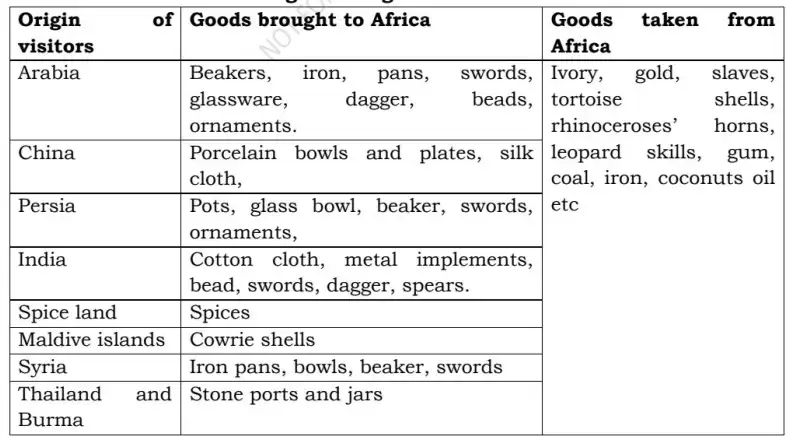
EFFECTS OF ECONOMIC INTERACTIONS IN AFRICAN SOCIETIES
Early interactions between the African people by 19th c had many effects in their societies.
1. Availability of goods which the people of African societies had not produced in their region.
For example, the West African societies obtained dates and salt from Taghaza in the Saharan desert since lithe A.D. The I-la in Uvinza obtained copper from eastern Congo to produce ornaments, and bangle from copper.
2. Development of strong political organization
Several societies succeeded to be politically strong because of the trade item received during the contacts. The leaders such as Tunka Manan of Ghana Empire and Musa Mansa Kankan of Mali used to get firearms which were used to expand their empires between 5th c and 17th c A.D. in West African Savannah region. In Eastern Africa chiefs such as Mirambo and Machemba of the Yao in Tanganyika obtained tax in terms of clothes which were provided to the soldiers in order to avoid opposition to their rule.
3. Development of towns
Many areas were turned as trading centers with many buildings which were constructed to keep the items and accommodate the traders. In East Africa Bagamoyo, Kilwa, Mombasa, Tabora and Ujiji became towns while in West Africa Jenne, Gao Timbuktu, and Walata were famous towns during the interactions across the Saharan desert.
4. Development and growth of agriculture
Expansion of agricultural products to feed those who interacted other people grew during the economic contacts.
5. Inter-marriages occurred because some people decided to get married to the people they met outside their societies. Inter-marriage actually led to the rise of generations with mixed elements of ethnic groups. For instance the Haya in Karagwe were married to Baganda because of economic interactions during the 19th c.
6. Development of technical skills and new ideas
Interaction led people of Africa from different communities to share their skills and ideas for economic growth
7. Overexploitation of African resources
Interaction among African people resulted in overexploitation of African resources through trade which was unequal in nature.
8. Emergence of classes among the Africans
Classes emerged dividing poor Africans from rich Africans who accumulated wealth from different economic, social and political activities.
9. Exposure of Africa to the outside world
African country and its resources came to be exposed to the outside world due to interaction. Decrease of productive manpower due to slave trade; through interaction the outsiders started to take slaves from Africa to their mother countries as labor power.
10. Population increase
Areas that attracted large numbers of people became highly populated, especially productive areas. The increased population resulted into socio-economic development in the given areas which facilitated immigration.
11. Emergence of new languages
As different people interacted new languages emerged. For example, the Swahili language emerged due to interaction between Arabs, Africans and Europeans.
12. The interaction laid down foundations for the present social, economic and political activities which take place between different regions of Africa.
For example the presence of sports, formation of economic organizations like East African Community (EAC) and co-operation in solving conflicts in some nations like Burundi, Congo and Sudan in 2000’s have been important interactions being inherited from the days before colonial rule. The interactions seen to date were built up since the I9thc
I: INTERACTIONS IN SOUTHERN AFRICA
Before colonization, Southern Africa was a region of dynamie socio-economic and political interactions. These interactions shaped the development of various communities and fostered trade, migration, warfare and cultural exchanges.
A good example of pre-colonial interaction in Southern Africa is the Ngoni migration, which involved Nguni speakers moving from Southern Africa to Central and East Africa in the 19h century.
Factors for early interaction in southern Africa.
1. Migration
During the early period (1000-1500 CE), migration influenced interactions in Southern Africa. The Bantu migrations into Southern Africa shaped the region’s population, economic activities and culture. For instanee, the Bantu introduced iron- working, agriculture and new political siructures, thereby facilitating their interaction with the indigenous San and Khoikhoi groups.
2. Trade
it was another significant factor in the early interactions in Southern Africa. The Indian Ocean trade network brought goods such as beads, cloth and ceramides into the interior of Southam Africa. The Swahili city-states on the East African coast, such as Kilwa and Sofala, facilitated these trade links. The Great Zimbabwe state (cirea 1100-1450 CE) became a major centre of gold trade, linking Southern Africa with the broader Indian Ocean worlds. Gold, ivory and cattle were exchanged for luxurious items, thus integrating Southam Africa into the global trade networks.
3. The Mfecane (1815-1840)
A series of forced migrations and conflicts, had roots in the competition for land and resources that began in the 18th century and exemplifies the Southern African interactions.
A brief history of Mfecane
The word Mfecane is derived from the Nguni language which means; crushing or grinding or the war of wondering The Sotho called it “Defecane” to mean the same period. It was also called “Lifecane” by other peoples of South Africa
It was the period of upheavals and population migration which occurred in zuin land in south Africa in the 19th century 18001830s. It took place among the sastern Bantu tribe such as the Ngwane under Sobhuza .. Mthethwa under Dingiswayo. Ndwandwe under Zwide. Minor group of the Zulu clan under Senzangakona The rise of Mfecane among such groups happened when the groups started to conquer each other.
Causes of the Mfecane
Increase of population.
This was the main internal factor that led to Mfecane,, in Nguniland population rapidly expanded that it outmatched the available resources. As land became inadequate for farming and pasture. The demand for land raised conflicts that forced Nguni tribes adopt regular armies to fight for more land, thus Mfecane.
The struggle to control trade with the Delagoa Bay. From the late 18th C. European maritime traders at the Delagoa Bay ware trading with African societies like the Mthethwa, Ndwandwe and Zulu. The struggles to control the trade and acquire items like slaves, ivory and gold needed by maritime traders led to conflicts among the chiefdoms.
The Boers expansion northwards
The Boer Trek in the interior intensified the severity of Mfecane. With their determination to control any fertile land in the interior, the Boers fought African tribes included the Zulu, Nguni, Xhosa and Kumalo. The wars caused a lot suffering as tribes started fighting each other for the little land left.
Rise of Zulu – Tshaka
This contributed to the development of Mfecane. He was a powerful leader with strong army, which used short stabbing spears to fight the other clans by defeating and absorbing them into his chiefdom
Territorial expansion
Made various clans wage the wars among themselves. Each clan desired to expand boundaries in order to make a larger territory
The great pride in military skills of Nguni trial leaders. The Nguni tribal leaders like Zwide of the Ndwandwe and Shaka of the Zulu fought each other to control the region by forcefully incorporating their neighbours into their hegemony.
Deadly cattle raiding acts.
The Nguni adopted lethal cattle raiding activities against each other to expand their herds. As herds expanded communities competed for more grazing lands. The two; cattle raiding and need for more pastureland resulted in endless conflicts which ultimately led to Mfecane.
Transformation from communal to feudal system.
Emergence of classes gave way to the rise of strong landlords – tribal leaders who were itching to consolidate power
by acquiring more land. This settled the Nguni into small but rival chiefdoms such as Ngwane, Mthethwa, Zulu and
auwawandwe which contested for control of land in the region.
Attacks by the Griquas
Since the early 19th C, coloured people from the Cape colony, known as Griquas, were a source of instability among the southern Bantu communities. Using horses and firearms, the Griquas from time to time attacked the Nguni societies like the Sotho and capture women and children whom they sold as slaves to the Boers and British farmers
EFFECTS OF THE MFECANE
Mfecane was indeed one of the notable 19th C African revolutions that have far reaching effects that touched a vast region of South, Central and East Africa. However much it brought havoc, it also brought considerable military, political and social development. The effects include;
i. Massive depopulation
Large parts of southern Africa namely, the regions of Natal, Orange Free and Transvaal states were largely depopulated. Some societies were annihilated as thousands were massacred and more forced to flee from the constant tribal wars ..
The spread of Zulu military techniques to the same areas.
For example, many societies in East and Central Africa adopted the Ngoni’s weapons such as short stabbing spears and long shields. They also adopted fighting techniques such as the use of cow-horn formation when confronting enemies.
It led to the growth and consolidation of large states in Central and East Africa
As the Ngoni moved northwards, they destroyed states such as Rozwi in Zimbabwe, Lozi in Zambia, and Undi in Malawi. The Ngoni set up multi-ethnic states of different sizes. They included the Ndebele State in Zimbabwe, the Shangani State in present-day Mozambique and various Ngoni states in present-day Zambia, Malawi and Tanzania
Depopulation in Natal
The number of people decreased in larger areas such as the Veld. They died during the wars while others flew from the region and concentrated themselves in other regions, which could be defended from frequent attacks by Shaka soldirs.
Separation of Bantu tribes
Mfecane forced migrations of several Nguni tribes from southern Africa. The migrating tribes like the Ngoni and Ndebele also invaded societies they came across forcing them out. This chain of reaction led to continuous trouble and migrations that redistributed Bantu tribes in South, Central and East Africa.
Emergence of powerful military leaders
The severity of tribal wars led to the rise of strong military leaders who emerged to defend their tribes. The leaders included Shaka of the Zulu, Mzilikazi of the Ndebele and Moshoeshoe of the Basulo.
The fall of peace in many societies neighbouring South Africa existed due to Mfecane
Many groups which moved away from Natal conquered local people on their way and disturbed peace. Zwangendaba fought the Shona of Mwenemutapa in the movement to the North and disorganized the people in Eastern Africa especially in the West and South of Tanganyika.
Mfecane helped the Boers to settle in large areas of Natal and the Veld
This is because many people had left the areas when the Boer Trek started in the 1830s. The Boer settlers were able to take over land which was left unoccupied as a result of Mfecane in Natal.
Military transformation.
The intensification of tribal wars, forced the Bantu tribes to have a military outlook that they never had before. Certainly, southern Africa became a home of military innovation. For instance Shaka the notable military innovator introduced new weapons, the Assegai (short stabbing spear) and new tactics like the age-regiment system and cow-horn military strategy. Such inventions were previously unknown in local warfare.
Death of Shaka Zulu
Shaka was murdered by his own brothers Dingane and Mhlangane on 14th December 1828 with the help of Mbhopa; Shaka’s Induna. Shaka was killed because of his brutality especially after the death of his mother Nandi
Ngoni migration
Mfecane resulted into the migration of Nguni-speaking people to Central and East Africa. These people were called the Ngoni in Tanzania, Zambia and Malawi; the Matebele in Zimbabwe; and the Kololo in South-eastern Zambia
NGONI MIGRATION
The Ngoni were Bantu-Nguni speaking people of Northern Zululand in South East Africa. They were originally Ndwandwe people under Zwide’s leadership. Ngoni migration was the movement of the Ngoni people from Natal in South Africa to Central and East Africa. Their migrations started in the 1820s as a result of the Mfecane wars
The arrival of the Ngoni in Tanzania (Tanganyika)
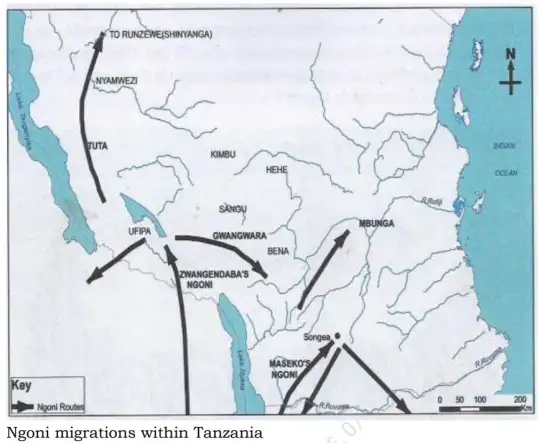
The Nguni-speaking people moved out of the Natal region in South Africa in different groups and went to different areas under different leaders. For example, Shoshangane led his group north-eastwards to Mozambique. Moshoeshoe and his people went to the present-day Botswana. Sebituane and his group moved into the present-day Zambia and Mzilikazi and his people settled in Zimbabwe. The Ngoni who came to Tanzania were in two groups. The first group was under the leadership of Zwangendaba and the second one under the leadership of Mputa Mseko
A. The Ngoni under Zwangendaba
Zwangendaba led the first group of Jere-Nguni speakers. He left the Natal region in the 1820s, after he had gathered some followers. Zwangendaba and his people crossed the River Zambezi in 1835. This group arrived and settled for some time in Ufipa in about 1840. Zwangendaba died in 1845. After his death, his followers split into five sub- groups. The groups were the Tuta, Gwangwara, Mpenzane, Mombera and Ciwere. Two of these groups, the Gwangwara and Tuta, remained in Tanzania and the rest moved into and settled in Malawi and Zambia.
The Tuta group
From Ufipa, the Tuta under Mpangalala moved northwards to the area called Shinyanga region at present. Along the way they raided and defeated the Holoholo people, who shortly reorganised themselves and defeated the Tuta. From this time onwards, the Tuta fought many other wars in north-western Tanzania and eventually settled in the Runzewe area of present-day Kahama District in Tanzania
The Gwangara group
The Gwangwara group, led first by Zulu Gama and later by Mbonani, moved south- eastwards from Ufipa to Songea district,. Before settling permanently in Songea, the Gwangwara clashed with the Hehe. The clashes gave the Hehe a chance to reorganize into a more centralized society under Chief Munyigumba in the late 1860s and early 1870s.
B. The Ngoni under Mputa Maseko/ the Maseko Ngoni
The second group of the Ngoni was led by Mputa Maseko; they were known as the Maseko Nguni-speaking people. They came from the Natal region via Malawi and settled in Songea in the 1 840s. They were later invaded by the Gwangwara, who arrived there in the 1860s.
The two groups fought a war. Maseko and his men were defeated and went to settle in northern Malawi. Some of his followers moved to the north of Songea and settled permanently in Ulanga -Kilombero. They came to be known as the Mbunga.

REASONS FOR THE SUCCESS OF THE NGONI PEOPLE
In their migration the Ngoni achieved to defeat the natives especially those in East Africa due to the following reasons
The Ngoni had strong military.
They had well-organised armies which had superior techniques and weapons compared to those of their enemies. For example, in the fights they used the cow-horn formation technique in which the Ngoni warriors could get close to their enemies, encircle them, and kill them in large numbers using short stabbing spears (assegai), and long shields
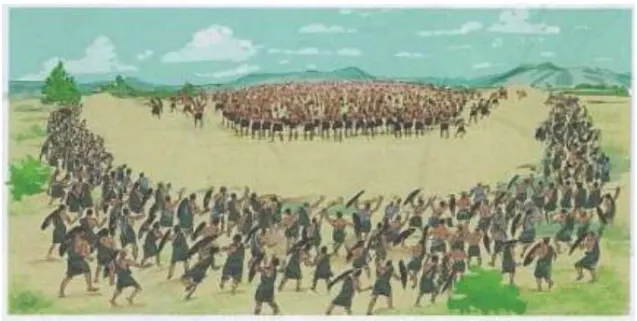
Cow-Horn formation Technique
The incorporation of war captives into their own groups
As the Ngoni fought wars with the people they met en route, they incorporated the war captives into their own groups. Those who resisted were killed. The male captives were included in the military, while the women were turned into wives. The incorporation of the war captives into the Ngoni groups increased the size of their population and strengthened the military.
Strong and efficient leadership
The leaders united their people and organised the military effectively. They also motivated their warriors by promising that they would give them rewards such as land, cattle and women. This, in turn, made the Ngoni warriors remain loyal to their leaders and fight bravely.
The disunity and weaknesses of communities they encountered
In their movement to the north, the Ngoni met people who lacked unity and had weak military capabilities. In some areas people were organised into clans and were living in small villages. Such people could not fight effectively the Ngoni intruders who were in large numbers, well organised and relatively better trained than them.
The use of the scorched-earth technique in the fights gave the Ngoni a relative advantage over communities they attacked.
The Ngoni marched in small groups and behaved ruthlessly when attacking their enemies. They plundered the areas and the people they conquered. Through this method, they took everything valuable from the defeated people, burnt their houses and destroyed farms as well as crops. The scorched-earth technique weakened invaded communities because it caused shortages of food, displacement of people and loss of weapons and other kinds of property.
The Ngoni came in big numbers and were strong
On their way they absorbed or fought off the people they encountered, capturing the young for worries and young women for wives. They had good military organization with age-regiments called “impis” (strong army).
The East African people were caught unaware and therefore did not offer much resistance.
The Ngoni were successful because the local people whom they were fighting with were so weak and lived in small groups, which could not resist/challenge the sudden and unexpected Ngoni invasion.
THE CAUSES OF THE NGONI MIGRATION
i. Dictatorial rule of Shaka
Shaka Zulu was cruel in nature as he severely tortured people and those who failed to respond to his order were killed. Due to this some people decided to seek refuge by migrating to other areas.
ii. External pressure from the British and Boers
They moved because of external pressure from the British and Boers in the South who were moving Northwards occupying their land.
iii. It was due to overpopulation in Natal
This was caused by the fertility of soils and the availability of rainfall between Drakensberg Mountains and the Indian Ocean.
iv. Pastorals’ reason
Some Ngoni people owned large herds of cattle which forced them to move northwards looking for pasture and water for their animals. So theymwanted to look for more fertile land for their cattle. They also experienced famine and drought that led to lack of food and water.
v. The influence of their leaders
Men like Zwangendaba, Mputa and Zulu Gama provided good leadership. This encouraged them to move onwards.
vi. Overstocking
It could also have been due to overstocking of their animals as they were having spirit of cattle rustling, i.e. they had great desire to steal other people’s cattle. For example they went on driving away and confiscating other people’s cattle during their conquest and expansionist wars.
vii. Increased knowledge of military tactics by the age regiments
These were powerful military forces and dedicated to professional war, which was their livelihood. They believed that they could have other territories through migration.
viii. The Mfecane war
This was the period of political instability and upheavals in South Africa, As a result of this contradiction wide warrior divided into two groups one was Under Shoshangane created Gaza Empire in Mozambique and Zwangendaba migrated northern wards through central Africa into present day Tanzania .- One group under Mputa Maseko crossed Zambezi River and passed to Eastern side of Lake Malawi (Nyasa) finally settled in present day Songea district
EFFECTS OF THE NGONI MIGRATIONS
(a) Social effects
The occurrence of frequent wars in the societies
That were previously peaceful such as those of Ufipa, Songea and Unyamwezi. The wars caused social disturbances and unrest in the societies concerned.
Death of people
Ngoni migration caused the occurrence of deaths and injuries among the Ngoni fighters and their opponents. Some people died, while others were badly wounded. The wars also caused famine as the Ngoni destroyed crops and farms, plundered food, burnt houses and destroyed granaries of societies they invaded
Intermarriage between the indigenous people and the Ngoni
Some Ngoni men, married women war captives.
Separation of families.
The Ngoni raids forced weak ethnic groups to move from their,places of origin to others. For example, the Ndendeule moved from their originalMhome in Songea to Namtumbo, where they established new settlements. Similarly, the Amang’anja of Malawi moved from their homeland on the western side of Lake Nyasa to the eastern side of the lake in response to the Ngoni raids.
Introduction of new culture
However, there was spread of Ngoni customs and culture. They enriched the cultures of the people of Southern Tanzania, for example, people copied Ngoni traditional dances and annual festivities
Introduction of new military tactics and weapons
i.e cow horn formation tactics, assegai, cowhides and shields.
(b) Political effects
Ngoni migration contributed to the rise of strong centralized states in the two regions
The societies which did not accept Ngoni domination strengthened their states militarily in order to defend themselves against the Ngoni warriors. These societies adopted new military techniques and weapons from the Ngoni. Examples of such societies were the Nyamwezi, Hehe, Sangu and Kimbu.
Ngoni migrations led to the decline of some states in Central and East Africa.
In all the areas through which they passed the Ngoni destroyed almost everything they came across, including houses, crops and cattle. This destruction weakened a number of states. For example, the Ngoni weakened the Rozwi ruling dynasty of the Mwenemutapa Empire in Zimbabwe.
Ngoni migrations disrupted societies in many parts of Central and East Africa.
They disrupted political stability and social coherence in the societies. For example, the raids weakened and disrupted many societies in western and southern Tanzania. The disruptions made it easy for some coastal slave traders to obtain slaves from those societies during the second half of the 19th century.
(c) Economic effects
Ngoni migration led to the decline of agricultural production
As a result of the Ngoni invasions, agricultural production declined as many young men were recruited into the Ngoni armies. Also, owing to prolonged wars, people became restless and therefore could not produce food. They spent most of their time hiding from the Ngoni raids.
Ngoni migration consolidated slave trade in East Africa
The Ngoni raids weakened many societies, which made it easy for slave traders to capture or buy slaves. Sometimes people sold captives to the traders so as to obtain guns which they used to fight the Ngoni. The Ngoni also sold some slaves to them.
The Ngoni disrupted and diverted trade routes
For example, the Long Distance Trade routes were frequently changed in fear of the Ngoni. The disruptions and diversion of the routes negatively affected economic development in various societies.
It led to the destruction of properties
Ngoni were moving in large groups destroying crops and other properties wherever they crossed. Villages that tried to resist were in most cases burnt down.
II: INTERACTIONS IN EASTERN AFRICA
Eastern Africa experienced interactions with other communities within and outside Eastern Africa, long before European colonialism,
Factors for interaction in Eastern Africa
Various factors shaped the interactions between and among the communities
1. Migration, in Eastern Africa
The Bantu migration, which had started centuries earlier, continued to shape the region’s demographics. Bantu-speaking communities moved across Central and Eastern Africa, introducing agricultural techniques such as iron hoes, manuring, crop rotation and intercropping, ironworking and social structures that influenced many communities.
Examples of these Bantu are the Shona, Bemba, Baganda, Sukuma, Lingala, Nyamwezi, Gogo and Kikuyu. The Nilotic migration like the Lango, Kalenjin, Luo and Maasai. from Nile valley into present-day Uganda, Kenya and Tanzania is another good example which shaped Eastern Africa’s interactions, Sometimes the interactions between the Bantu and the Nilotes involved conflicts over pasture, land and fresh water.
2. Religious and cultural exchanges
This were deeply intertwined with trade and migration. The arrival of Islam on the East African coast in the 7th century led to significant cultural transformations. By the 12h century, many Swahili city-states had adopted Islam, thus integrating Islamic values and practices into their daily lives.
The interaction between Islam and local cultures led to the development of Swahili culture, which blended African, Arab and Persian elements. Kiswahili, a Bantu language heavily influenced by Arabic, became a lingua franca on the coast and beyond.
3. Intermarriage
This was also one of the social factors for interaction between the Asian merchants and local populations, particularly where Arab, Persian and African communities interacted and intermarried. This led to the development of a distinct Swahili identity that was s neither entirely purely Arab but rather a fusion of both.
4. The political and military interactions
Also shaped the history of pre-colonial Eastern Africa. The rise of centralized states such as the Buganda, and Bunyoro Kingdom, led to the forging of alliances and conflicts with neighboring groups. The Buganda Kingdom expanded its influence through military conquests and it incorporated various smaller communities into its political structure.
5. Trade
This was a significant factor in the pre-colonial interactions across Eastern Africa. The region was a center of commercial activity, linking the interior with the coast and global trade networks. The Swahili coast, stretching from present-day Somalia to Mozambique, was crucial in facilitating the long-distance trade between the Middle East
and Asia. The coastal city- states of Kilwa, Mombasa, Malindi and Zanzibar were major trading centers, where African merchants exchanged goods with Arab, Persian, Indian and later Chinese merchants.
The Participants in the Trade
The Kamba, Baganda, kikuyu, and Banyoro carried trade activities along the northern route. On the central route the Nyamwezi were out spoken providers of caravan porters, the leader of this caravan was Chief Mirambo. On the southern route The Yao became the first prominent traders, chief Mponda and Motaka were the one who mobilized them Items of trade.
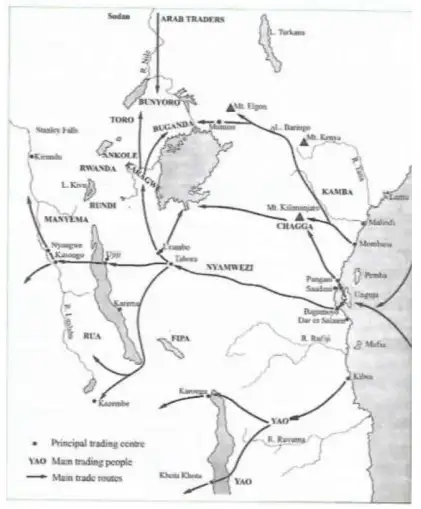
The key commodities included gold from the interior (notably from present-day Zimbabwe), ivory, anima skin, and slaves, which were highly needed in Middle Eastern and Asian markets. In return, Eastern African communities received textiles, needles, swords, glasses, beads, ceramics and luxury goods such as spices from India.
FACTORS FOR THE RISE OF THE TRADE
The commercial development occurred in East and Central Africa between 1855-1914 and was marked by the an exchange in trade items, thanks to the relationship with Asia, Arabia and Europe, trade grew up voluminously between 1855-1914 for the demands exceeded the supply, thanks to the death of local products at the coast. The Swahili and Arab traders stationed at Zanzibar migrated to the interior for they were attracted by the richness of East and Central Africa
The trade developed due to the following factors;
i. The growth of iron technology
In some tribes of theinterior of East Africa spurred the expansion of the long distance trade, like the Bunyoro and Nyamwezi were involved in blacksmithing, they made different iron equipments that included hoes, axes, pangas, and also produced salt. Tribes that were formally engaged in forming routes joined with tribes like the Bunyoro, the Nyamwezi, and the Kikuyu in the long distance trade because in doing so they obtained needed goods and because it was very profitable,
ii. The expansion of the industrial revolution from England to other European nations
Partly accelerated the development of long distance trade, local products like ivory, minerals turned out to be lucrative to the European during the second half of the nineteenth century, high demands of local products pressurized the traders to move deep in the interior of east Africa to obtain cheaply ivory and minerals.
iii. The shift of sultan sayyid said from Muscat Oman to Zanzibar in 1840
He and other Arabs traders created clove plantations in order to over satisfy the over expanding needs in the European market, in order to boost production he wanted cheap labor which could be offered by slaves who could be obtained from the interior parts of Africa.
iv. Introduction and availability of fire arms
Also was instrumental in contributing to the development of long distance trade, the presence of fire arm made it easier for Chokwe, Bisa, and Nyamwezi people to transform their traditional skills into modern ones to attract the available market and also aided those who were involved in slave trade to easily acquire captives.
v. The division of labor and specialization
Among the Chakwe and seasonal pattern of the land use among the Nyanwezi West Central Tanganyika, after preparing the land for planting men would leave the work of harvesting to women, men would travel far of hunting ivory and transacting trade for several months without checking back on their homes.
vi. High demands of imported European and Asian products
For example clothes, and fire arms.
REASONS FOR THE DECLINE OF LONG-DISTANCE TRADE IN EASTERN AFRICA
i. Inter-tribal wars
By 1880 competition for long distance trade items had come to its climax with many new East African societies interested in joining the long-distance trade business for example in Kenya the Akarnba fought with the Nandi in competition for rare products such as ivory which Arabs wanted most in Kenya.
ii. Presence of insecurity created by bandits almost in all trade routes
They had a problem of way layers for example the central route that was occupied by the Nyamwezi had a group of bandits known as Rugarugaand Mvuiwho molested traders from the central routes where as the hostile Zaramo, Ukimbu, Porkorno, molested traders from Kenya
iii. The depletion of elephant’s population
Due to over hunting indeed affected ivory products, also contributed to the decline of long-distance trade by 1890s the elephants had been forced to migrate to distance areas also they were killed in large number especially after the introduction of guns.
iv. The death of outstanding long-distance traders
Continuous assassination of African chiefs by Swahili and Arabs traders in search of trade items contributed to the decline of long-distance trade, Mirambbo, Nyungu ya mawe, and Kabaka mutesa I of Buganda all died in the same year of 1884 whose active participation and organizational abilities had led to success of long-distance trade, unfortunately their successors lacked such abilities.
v. Introduction of legitimate trade by European traders
During the period of scramble for and partition of Africa in 19th century led to the decline of long-distance trade.
THE IMPACTS OF THE LONG-DISTANCE TRADE
The integration of African economy into the world capitalist economy
Africa was producing many raw materials that were absorbed by the outside world and in return was receiving goods produced by the outside world.
There was introduction and spread of new cash crops
New cash crops introduced from the coast to the interior that helped people to get both food and cash crops, those included maize, rice, pineapple and sugar,
The use of caravan route for inland penetration
The caravan routes latter became useful for inland penetration by European explorers, missionaries and traders. In their enterprises used the routes that had been utilized by traders and without them the European colonial agents would have encountered many setbacks.
Introduction of monetary system
It created monetary system that took the place of barter system of trade, the new form of trade was introduced including cowries’ shells, coinage, and paper money
Development and growth of Some towns in East Africa
Development of towns in East Africa, for example Tabora, Bagamoyo, Tanga, and
Increased intermarriage and social interaction in East Africa
Increased intermarriage and social interaction gave rise to Afro-Asiatic, Afro-Arabic, and Afro-European culture in Africa.
Improvement of relationship among the Africans
Long distance trade helped to improve relationship between some African societies which had before, for example the Kamba and the Nandi tribes in Kenya had to ignore their traditional differences in order to trade freely as friends.
Depopulation
The trade involved itself in selling of human being who greatly depopulated most of East and Central African societies.
It led to the state formation in East Africa
This came out as the result of individuals who acquired wealth and other opportunities from long distance trade that helped them to build large political kingdoms for example Nyungu Ya Mawe, Mutesa I, Mirambo, were able to build their kingdoms as a result of opportunities from the long-distance trade.
The Increase of production of Local food stuffs
The long-distance trade stimulated the production of local food stuffs required to meet food demands of caravan traders who did not carry food supplies along the way.
III: INTERACTIONS IN WESTERN AFRICA
The region OF Western Africa was not isolated but deeply connected to the broader African, Mediterranean, Arab and later Western worlds. The interactions laid the foundation for later historical developments, including the colonial intrusion and resistance movements.
Factors for interaction in western Africa
1. Political alliances
For example the Ghana Empire (c. 300-1200 CE) developed political relations with North Africa traders and Berber groups, thus allowing safe passage for merchants. The Mali empire (c. 1235-1600 CE), under rulers like Mansa Kankan Musa, strengthened diplomatic ties with North Africa and the Middle East. Mansa Musa’s famous visit to Mecca (1324) enhanced Mali’s international reputation and established direct relationship with the Islamic world
2. Religious influence
Islam was a major force in shaping the interactions that took place in pre-colonial West Africa. The spread of Islam was facilitated by the North African traders and scholars who settled in West African trading towns, Cities like Timbuktu, Djenné and Gao became Islamic learning and scholarship centres . The development of Islamic influences led to the construction of mosques and learning centres such as the Great Mosque of Djenné and the University of Sankore in Timbuktu
3. War and military
War and military expansions also facilitated the interactions among West African societies. For example, the Oyo Empire (present-day Nigeria) expanded through military campaigns using cavalry forces. Likewise, the Dahomey Kingdom (present- day Benin) had a strong military tradition, including the Amazons of Dahomey, an elite female warrior corp. The Sokoto Caliphate founded by Usman dan Fodio in 1804 also waged a series of Jihads that reshaped political structures in the region
4. Trade
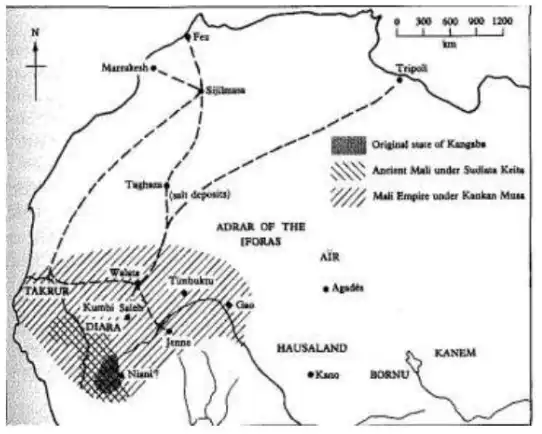
One of the most significant factor of interaction in pre-colonial West Africa was local and regional trade, popularly known as the Trans-Saharan Trade. The trade facilitated the interaction between the people of western Sudan and north Africa and Islamic world leading to economic growth, the expansion of empires and cultural exchanges between different communities. The Trans-Saharan Trade network linked West Africa to North Africa.
Brief discussion about trans Saharan trade.
This was the exchange of goods between Western Sudan and North Africa passing through the Saharan desert.The term “Trans” means across. The Northern people who took their goods across Saharan desert to Western Sudan were the Berbers and Touaregs, also from the Northern Sudan some goods came from Europe and Asia consisted of cotton and silk clothes, swords, guns, metal pans and horses, Commodities that originated from Western Sudan included slaves, ostrich feathers, kola nuts, gold, salt, ivory and food stuffs, Camel were used as the primary means of transport, the Berbers passed through the Saharan desert and collected commodities from Western Sudan, the medium of interchange of goods and services was barter system later cowries’ shells from
Maldives were used as means of exchange, these replaced barter system.
The trade involved different zones which were ranging from Forest i.e. involving the forest states like Benin, Oyo, Kanem, Bornu, and many more. The savannah belt which involved the Western Sudanic states (Ghana, Mali, and Songhai) the Sahara Desert and the North Africa, the Mediterranean world and Europe.
MAJOR TRANS SAHARAN TRADE ROUTES
There were three main trade routes.
- The Western route
- The Central route
- The Eastern route
1. The Western route
This trade route started at Fez in morocco and passed through Sijimasa, Taghaza, Taoden, Walata, Audaghost, and Timbuktu. The Western route was famous because of the salt work at Taghaza and gold mines of Wangara.
2. The Central route
This trade route started at Tunis and proceeded to Tuata, taotek, tadmekket, Timbuktu, Gao, kano, and katsina.
3. The Eastern route
This route originated in Tunisia in Tripoli, Alexandria and Cairo, and proceeded to murzuk, Ghat, Agades,
and Bilma, this trade route was significant due to the salt mine in Bilma.
FACTORS FOR THE GROWTH OF THE TRANS SAHARAN TRADE
i. Political Growth and development
That was evidenced during the 7th century and 16th century cases in point include the Western Sudanic states whose rulers promoted the expansion of the trade, they ensured this by giving a leading hand, security and freedom of movement and also encouraged their people to prepare the goods that were necessary in the trade, examples of these leaders include Askia Mohamed, Mansa Musa, and Tunka Manin,
ii. The conquest of North Africa by the Arabs between 641 and 708
When the Arabs conquered North Africa them being traders naturally, they did introduce their trading system and on top of that they increased the use of camels in North Africa and in the Saharan desert.
iii. Development of production in various regions of the Sudanic zone
As production increased it meant that the supply of commodities to be used in the trade was available as no single community is self-sufficient; this meant that the different societies had to depend upon each other facilitated by the development of production like mining and hand crafts.
iv. The Berbers of the North and the African traders of west Africa trusted each other
These two societies conducted trade without panic of fraud, theft and robbery hence the entire atmosphere of the trading promoted further trade,
v. Its locality and climatic condition facilitated the development of the trans Saharan trade
These two factors facilitated the voluminous production of kola nuts and food stuffs that were badly needed, many parts of Western Sudan never had impassable forests therefore the traders could travel easily with no any setbacks.
vi. Adoption and development of Arabic language in West Africa
Arabic language was adopted as a medium of communication which the merchants used in trade transaction hence with the clear medium of communication the trade accelerated
vii. The introduction and use of camels in 100A.D
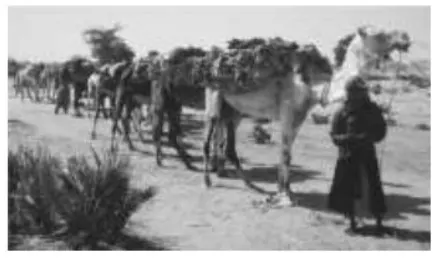
The camels were able to carry more loads than any other animals, the camel can withstand harsher weather than other animals, a camel can stay a very long time without drinking and can still move ahead even with a heavy load on its body. This made the use of Sahara Desert as a route for business between West Africa and their Northern neighbors very successful.
IMPACTS OF THE TRANS SAHARAN TRADE
i. It contributed to the formation of West African states and kingdoms
The profit that were raised from the trade helped in the development of the different states, these were got through the taking over the charge or control over trade routes and every one using that routes had to pay tax or tribute, examples of states developed due to this trade were Ghana empire, Mali empire and Songhai empire.
ii. Spread of Islam in West Africa
The traders were serving two masters at the same time, as they were traders at the same time acted as teachers of Islam a thing that improved literacy in the region.
iii. Emergence and development of towns in West Africa
Due to the trade many areas which previous were once villages turned into towns in what is known as urbanization small villages turned into large towns and cities such as Kumbi Saleh, Gao, Kano, Jenne, Timbuktu, and many other.
iv. The Improvement of political administration
The caravan routes improved political administration of different kingdoms and empires in West Africa through the use and employment of well-educated Muslims traders who had been attracted by the trade, many of the states were also applying Islamic ways of administration in their different areas of jurisdiction.
v. Exploitation of natural resources increased in West Africa
This was due to the influx of many whites in West Africa who then introduced unequal exchange in West Africa.
FACTORS FOR THE COLLAPSE OF THE TRANS-SAHARAN TRADE
i. The germination of suspicion and mistrust among the Arabs, Berbers and Africans
Thus it was unsecure for the merchants to wage trade bartering of commodities amidst the atmosphere of mistrust, fear, and suspicion drastically the rhythm of trade died away.
ii. Death of People and Depopulation
The major towns in North Africa and Western Sudan were affected by the epidemics of plague which claimed some lives of the people, due to these the traders from Europe and Asia fore west the idea of coming to North Africa and this decimated the volume of trade.
iii. Development of Triangular slave trade in the 15th century
Ivory and slaves were quickly and easily exported to Europe through the coast of West Africa hence the volume of goods carried across the Sahara decreased.
IV: INTERACTIONS IN NORTHERN AFRICA
Pre-colonial Northem Africa which comprises modern-day Egypt, Libya, Tunisia, Algeria and certain parts of Sudan and Mauritania was a region of rich interactions influenced by trade diplomacy and religious exchanges. Due to its strategic location, Northem Africa became an important zone for cross-continental interactions between Africa and Asia. The interactions shaped the region’s cultural and economic foundations, many of which still exist.
Factors for interaction
Various conditions facilitated the interactions in pre-colonial Northern Africa.
1. The region’s geographical location and climate
Northern Africa strategic position between the Mediterranean Sea, the Sahara Desert and the Sea made it a center for trade, migration and conquests. Cities such as Carthage Alexandria and Tripoli became important trading ports which linked Africa with southern Europe and the Middle East. The Sahara Desert became a condition for the Trans-Saharan Trade, with camel caravans facilitating commerce between Northern and West Africa.
2. Migration and inter-ethnic relations
Also encouraged interactions in Northern Africa, contributing to demographic and cultural diversity, for instance, Arabs settled in Northern Africa, intermarrying with the Berber people and creating the Arab-Berbers identity in the 7h and gt centuries in the region (the Maghreb region),
3. Trade
The growth of trade networks in Northern Africa facilitated econ and cultural interactions. A good example is the Trans-Saharan Trade that linked North African merchants with West African kingdoms; they exchanged gold, salt and enslaved individuals. North African traders, especially the Berbers and controlled important trade routes and facilitated the exchange of goods between Saharan Africa and the Mediterranean world. The Berbers also contribute spread of Islam, serving as mediators between Arab traders and African communities.
4. Religion
Religion played an essential role in shaping interactions in Northern Africa, particularly with the introduction and spread of Islam. A good example was the Arab conquests (7 century CE), Following the rise of Islam, Arab armies expanded into Northern Africa, bringing the Arabic language and Islamic governance into the region. Indigenous Berber groups adopted Islam and helped spread it further into West Africa and the Sahel region.
5. Political alliances
The establishment of powerful states and empires in Northern Africa facilitated the forging of diplomatic relations and military cooperation with the neighboring regions. For example, Ancient Egypt’s (c. 3100 BCE-30 BCE) control over the Nile allowed it to interact with Nubia and the Mediterranean world. The Egyptian pharaohs- maintained trade and military alliances with communities, such as the Hittites and Greeks.
Similarly, the Carthaginian Empire (9- 20d centuries BCE), founded by Phoenicians in modern-day Tunisia, dominated the Mediterranean trade and had diplomatic relations with the Roman Empire and Greek city-states which facilitated the spread of Latin culture, Christianity and infrastructural development, such as the construction of paved roads. Christianity spread to Northern Africa in the 1″ century CE, especially in Egypt and Carthage
6. Wars
Conquests and military alliances played a role in shaping interactions that occurred in Northem Africa. For example, the Punic Wars BCE) occurred whereby Carthage fought against Rome in a struggle for domination over the Mediterranean world. After Carthage’s defeat, Rome gained Northern Africa. Another example was the Arab-Berber Resistance (7h- 8th Century CE) The Berbers initially resisted Arab rule but later allied with them, helping to expand Islam into West Africa and Spain